
Abstract
This report provides a comprehensive analysis of the ground penetrating radar market, which is poised for significant growth driven by increasing investments in underground utility mapping and infrastructure modernization. The scope covers various segments, including cart-based systems and antennas, across key sectors like construction, transportation, and municipal management. Technological advancements in AI-powered data interpretation, 3D imaging, and GIS integration are major market drivers. Furthermore, the study evaluates regional dynamics, particularly the US leadership in North America, and assesses the competitive landscape of key global players.
Related Questions
USD 0.53 billion in 2026, USD 0.92 billion by 2032
9.6% (2026-2032)
Hexagon AB (Sweden), SPX Technologies/GSSI (US), Hilti (Liechtenstein), Geophysical Survey Systems, Inc. (US), Chemring Group PLC (UK)
increasing investments in underground utility mapping, transportation infrastructure inspection, non-destructive testing applications
Summary
Market Overview
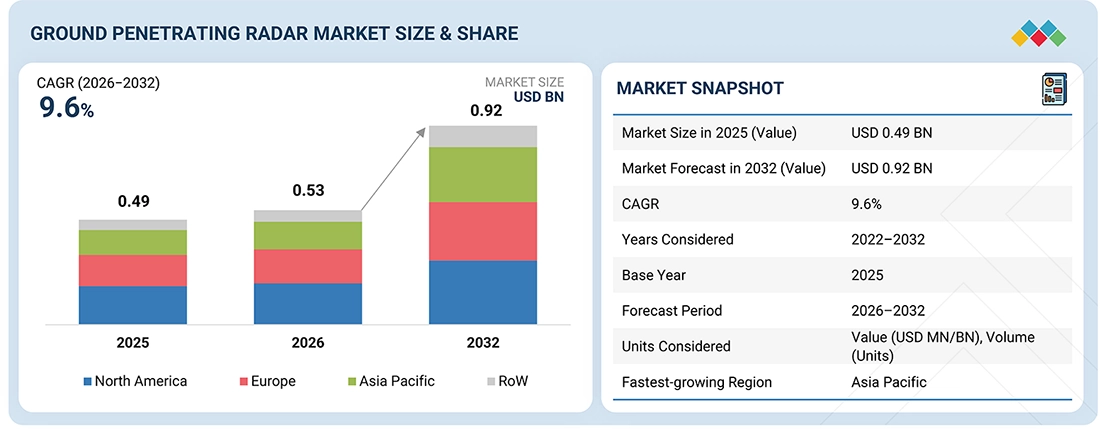
The global ground penetrating radar (GPR) market is projected to grow from USD 0.53 billion in 2026 to USD 0.92 billion by 2032, exhibiting a CAGR of 9.6% during the forecast period.
Market Drivers
- Infrastructure Investment: Increasing investments in underground utility mapping, transportation infrastructure inspection, and non-destructive testing applications across the construction, railway, and municipal sectors.
- Risk Mitigation: Rising concerns regarding utility strikes, aging infrastructure, and the need for improved asset management efficiency are driving the adoption of GPR technologies for accurate subsurface imaging and damage prevention.
- Technological Evolution: The transition toward AI-powered data interpretation, 3D imaging, GIS integration, and digital twin platforms is enhancing operational capabilities and decision-making.
- Smart City Development: Growing smart city investments and expanding railway deployment opportunities position GPR as a critical technology for next-generation infrastructure resilience and underground asset management.
Market Segmentation & Trends
By Product Type
Key Trend: The cart-based systems segment is projected to grow at the highest CAGR between 2026 and 2032.
- Growth Drivers: Mounting demand for large-area underground utility mapping, transportation infrastructure assessment, and municipal asset management applications requiring efficient, high-accuracy subsurface investigations.
- System Advantages: Cart-based GPR systems offer enhanced mobility, deeper coverage, and compatibility with multi-channel configurations, enabling rapid data collection across roads, railways, airports, and urban infrastructure projects.
- Integration & Innovation: These systems are increasingly integrated with GPS, GIS, and digital twin platforms to improve asset visualization, maintenance planning, and excavation safety. Adoption is further accelerated by investments in smart cities, aging infrastructure rehabilitation, and utility damage prevention programs. Continuous advancements in 3D imaging, AI-powered interpretation, and automated data processing are enhancing operational efficiency and scalability.
By Offering
Key Trend: The antennas segment captured a significant share of the ground penetrating radar market hardware in 2025.
- Segment Importance: Antennas serve as the core component of GPR systems, determining penetration depth, imaging resolution, and overall detection performance across various subsurface conditions.
- Growth Drivers: Increasing deployment of GPR systems across utility detection, transportation infrastructure inspection, concrete evaluation, and environmental monitoring applications.
- Application Areas: Strong demand exists across municipal infrastructure projects, railway inspections, construction activities, and underground asset mapping for both low-frequency and high-frequency antenna solutions.
- Capabilities: These systems enable the accurate detection of buried utilities, voids, reinforcement bars, and geological features while minimizing excavation risks and operational disruptions. Advancements in multi-frequency, multi-channel, and AI-enabled antenna technologies are enhancing imaging capabilities for complex infrastructure and smart city environments.
Regional Analysis
North America
Key Trend: The US is projected to capture the largest share of the North American ground penetrating radar market in 2032.
- Growth Drivers: Extensive investments in transportation infrastructure modernization, underground utility mapping, and non-destructive testing activities.
- Market Dynamics: The region benefits from the early adoption of advanced subsurface imaging technologies, strong spending on highway and railway rehabilitation, and increasing deployment of GPR systems for utility damage prevention and asset management.
- Strategic Factors: A growing emphasis on smart city initiatives, aging infrastructure renewal, and environmental assessments is accelerating GPR adoption across both public and private sectors. The presence of leading GPR manufacturers, continuous technological advancements in AI-powered data interpretation and 3D imaging, and increasing integration with GIS and digital twin platforms strengthen the US market position globally.
Competitive Landscape
Key Vendors
The ground penetrating radar market is dominated by several globally established players. The study includes in-depth competitive analysis, including company profiles, recent developments, and key market strategies for:
- Hexagon AB (Sweden)
- SPX Technologies/GSSI (US)
- Hilti (Liechtenstein)
- Geophysical Survey Systems, Inc. (US)
- Chemring Group PLC (UK)
Research Methodology
Extensive primary interviews were conducted with key industry experts in the ground penetrating radar market space to determine and verify the market size for various segments and subsegments gathered through secondary research.
Breakdown of Primary Participants:
- By Company Type:
- Tier 1: 35%
- Tier 2: 45%
- Tier 3: 20%
- By Designation:
- C-level Executives: 40%
- Directors: 30%
- Others: 30%
- By Region:
- North America: 40%
- Europe: 30%
- Asia Pacific: 20%
- Rest of World (RoW): 10%
Study Coverage
The report provides a comprehensive analysis including:
- Segmentation: Forecasts by product type, frequency, depth capability, sales channel, offering, application, and region.
- Ecosystem & Benchmarking: An ecosystem analysis of key stakeholders and competitive benchmarking of leading companies.
- Technology Assessment: Assessment of emerging trends such as AI-powered data interpretation, 3D imaging, GIS integration, and digital twin platforms.
Key Benefits of the Report
- Market Dynamics: Comprehensive analysis of market drivers (underground utility mapping, infrastructure modernization, non-destructive testing), restraints (reduced performance in conductive soils and high-moisture environments), opportunities (integration with GIS, BIM, and Digital Twin platforms), and challenges (balancing penetration depth with imaging resolution).
- Product Development/Innovation: Detailed insights into emerging technologies, R&D activities, AI-powered data interpretation, 3D imaging solutions, robotic and drone-mounted GPR systems, and recent product launches.
- Market Development: Information on lucrative markets across North America, Europe, Asia Pacific, and RoW, supported by infrastructure modernization, smart city projects, and underground asset management programs.
- Market Diversification: Exhaustive information regarding new products, untapped application areas, and technological advancements in utility detection, transportation infrastructure, environmental studies, and disaster management.
- Competitive Assessment: In-depth assessment of market share, growth strategies, product portfolios, and service offerings of leading players (Hexagon AB, SPX Technologies/GSSI, Hilti, Geophysical Survey Systems, Inc., and Chemring Group PLC).
Table of Contents
1 INTRODUCTION 29
1.1 STUDY OBJECTIVES 29
1.2 MARKET DEFINITION 29
1.3 MARKET SCOPE 30
1.3.1 MARKETS COVERED AND REGIONAL SCOPE 30
1.3.2 INCLUSIONS AND EXCLUSIONS 31
1.3.3 YEARS CONSIDERED 32
1.4 CURRENCY CONSIDERED 32
1.5 UNIT CONSIDERED 32
1.6 STAKEHOLDERS 32
1.7 SUMMARY OF CHANGES 33
2 EXECUTIVE SUMMARY 34
2.1 MARKET HIGHLIGHTS AND KEY INSIGHTS 34
2.2 KEY MARKET PARTICIPANTS: MAPPING OF STRATEGIC DEVELOPMENTS 35
2.3 DISRUPTIVE TRENDS IN GROUND PENETRATING RADAR MARKET 37
2.4 HIGH-GROWTH SEGMENTS 38
2.5 REGIONAL SNAPSHOT: MARKET SIZE, GROWTH RATE, AND FORECAST 39
3 PREMIUM INSIGHTS 41
3.1 ATTRACTIVE OPPORTUNITIES FOR PLAYERS IN GROUND PENETRATING RADAR MARKET 41
3.2 GROUND PENETRATING RADAR MARKET, BY PRODUCT TYPE 42
3.3 GROUND PENETRATING RADAR MARKET, BY OFFERING 42
3.4 GROUND PENETRATING RADAR MARKET, BY SALES CHANNEL 43
3.5 GROUND PENETRATING RADAR MARKET, BY APPLICATION 43
3.6 GROUND PENETRATING RADAR MARKET, BY REGION 44
3.7 GROUND PENETRATING RADAR MARKET, BY COUNTRY 44
4 MARKET OVERVIEW 45
4.1 INTRODUCTION 45
4.2 MARKET DYNAMICS 45
4.2.1 DRIVERS 46
- 4.2.1.1 Increasing adoption of NDT techniques in construction and infrastructure verticals 46
- 4.2.1.2 Growing investments in underground utility detection and
4.2.2 RESTRAINTS 47
- 4.2.2.1 High equipment acquisition and maintenance costs 47
- 4.2.2.2 Limited penetration depth and performance of GPR
4.2.3 OPPORTUNITIES 49
- 4.2.3.1 Increasing smart city projects and rising focus on
- 4.2.3.2 Growing use of GPR technology in military applications 50
4.2.4 CHALLENGES 51
- 4.2.4.1 Lack of standardized regulations and survey methodologies
- 4.2.4.2 Accuracy limitations caused by varying ground conditions
4.3 UNMET NEEDS AND WHITE SPACES 52
4.4 INTERCONNECTED MARKETS AND CROSS-SECTOR OPPORTUNITIES 53
4.5 STRATEGIC MOVES BY TIER 1/2/3/ PLAYERS 55
5 INDUSTRY TRENDS 56
5.1 INTRODUCTION 56
5.2 PORTER’S FIVE FORCES ANALYSIS 56
5.2.1 THREAT OF NEW ENTRANTS 57
5.2.2 THREAT OF SUBSTITUTES 58
5.2.3 BARGAINING POWER OF SUPPLIERS 58
5.2.4 BARGAINING POWER OF BUYERS 58
5.2.5 INTENSITY OF COMPETITIVE RIVALRY 58
5.3 MACROECONOMIC OUTLOOK 59
5.3.1 INTRODUCTION 59
5.3.2 GDP TRENDS AND FORECAST 59
5.3.3 TRENDS IN GLOBAL UTILITY DETECTION TECHNIQUES 61
5.4 VALUE CHAIN ANALYSIS 61
5.5 ECOSYSTEM ANALYSIS 64
5.6 PRICING ANALYSIS 65
5.6.1 AVERAGE SELLING PRICE OF GROUND PENETRATING RADAR
- 5.6.1.1 Average selling price of handheld GPR systems provided
- 5.6.1.2 Average selling price of cart-based GPR systems provided
5.6.2 AVERAGE SELLING PRICE TREND OF GROUND PENETRATING
- 5.6.2.1 Average selling price trend of handheld GPR systems
- 5.6.2.2 Average selling price trend of cart-based GPR systems
5.7 TRADE ANALYSIS 70
5.7.1 IMPORT DATA (HS CODE 852610) 70
5.7.2 EXPORT DATA (HS CODE 852610) 71
5.8 KEY CONFERENCES AND EVENTS, 2026-2027 72
5.9 TRENDS/DISRUPTIONS IMPACTING CUSTOMER BUSINESS 72
5.10 INVESTMENT AND FUNDING SCENARIO, 2022-2025 73
5.11 CASE STUDY ANALYSIS 74
5.11.1 USE OF AI-ENABLED GPR IN STADIUM REDEVELOPMENT PROJECT
5.11.2 ADOPTION OF MULTI-CHANNEL GPR SYSTEM AT ARCHAEOLOGICAL SITE
5.11.3 DEPLOYMENT OF GPR SOLUTION FOR ACCURATE IDENTIFICATION OF UNDERGROUND UTILITIES BEFORE FIBER-OPTIC INSTALLATION 75
5.12 IMPACT OF US TARIFF - GROUND PENETRATING RADAR MARKET 75
5.12.1 INTRODUCTION 75
5.12.2 KEY TARIFF RATES 76
5.12.3 PRICE IMPACT ANALYSIS 77
5.12.4 IMPACT ON COUNTRIES/REGIONS 78
- 5.12.4.1 US 78
- 5.12.4.2 Europe 78
- 5.12.4.3 Asia Pacific 79
5.12.5 IMPACT ON APPLICATIONS 80
6 TECHNOLOGICAL ADVANCEMENTS, AI-DRIVEN IMPACT
6.1 KEY TECHNOLOGIES 82
6.1.1 ARTIFICIAL INTELLIGENCE- AND MACHINE LEARNING-BASED
6.1.2 MULTI-CHANNEL AND 3D GROUND PENETRATING RADAR
6.2 COMPLEMENTARY TECHNOLOGIES 83
6.2.1 GEOGRAPHIC INFORMATION SYSTEMS AND BUILDING
6.3 TECHNOLOGY/PRODUCT ROADMAP 83
6.3.1 SHORT-TERM (2025-2027): SYSTEM OPTIMIZATION AND
6.3.2 MID-TERM (2027-2030): INTELLIGENT AUTOMATION AND
6.4 PATENT ANALYSIS 86
6.5 IMPACT OF AI ON GROUND PENETRATING RADAR MARKET 87
6.5.1 TOP USE CASES AND MARKET POTENTIAL 88
6.5.2 BEST PRACTICES FOLLOWED BY COMPANIES IN GROUND PENETRATING RADAR MARKET 89
6.5.3 CASE STUDIES RELATED TO AI IMPLEMENTATION IN GROUND PENETRATING RADAR MARKET 89
6.5.4 INTERCONNECTED ECOSYSTEM AND IMPACT ON MARKET PLAYERS 90
6.5.5 CLIENTS’ READINESS TO ADOPT AI-INTEGRATED GROUND PENETRATING RADAR SYSTEMS 90
7 REGULATORY LANDSCAPE 91
7.1 REGIONAL REGULATIONS AND COMPLIANCE 91
7.1.1 REGULATORY BODIES, GOVERNMENT AGENCIES, AND OTHER ORGANIZATIONS 91
7.1.2 INDUSTRY STANDARDS 93
8 CUSTOMER LANDSCAPE AND BUYER BEHAVIOR 94
8.1 INTRODUCTION 94
8.2 DECISION-MAKING PROCESS 94
8.3 KEY STAKEHOLDERS INVOLVED IN BUYING PROCESS AND THEIR EVALUATION CRITERIA 96
8.3.1 KEY STAKEHOLDERS IN BUYING PROCESS 96
8.3.2 BUYING CRITERIA 96
8.4 ADOPTION BARRIERS AND INTERNAL CHALLENGES 97
8.5 UNMET NEEDS OF VARIOUS APPLICATIONS 99
9 DATA OUTPUT TYPES IN GROUND PENETRATING RADAR SYSTEMS 101
9.1 INTRODUCTION 101
9.2 2D IMAGING 101
9.3 3D IMAGING 101
9.4 GIS-INTEGRATED OUTPUT 102
9.5 DIGITAL TWIN-COMPATIBLE OUTPUT 102
10 GROUND PENETRATING RADAR TECHNOLOGIES 103
10.1 INTRODUCTION 103
10.2 TIME-DOMAIN GPR 103
10.3 FREQUENCY-DOMAIN GPR 104
10.4 STEPPED FREQUENCY GPR 104
10.5 CONTINUOUS WAVE GPR 104
10.6 ULTRA-WIDEBAND (UWB) GPR 105
10.7 3D GPR IMAGING 105
11 GROUND PENETRATING RADAR MARKET, BY OFFERING 106
11.1 INTRODUCTION 107
11.2 HARDWARE 108
11.2.1 ANTENNAS 111
- 11.2.1.1 Shielded antenna 113
- 11.2.1.1.1 Ability to minimize external electromagnetic interference and deliver high-resolution subsurface imaging to spike demand 113
- 11.2.1.2 Unshielded antenna 113
- 11.2.1.2.1 Expansion of geotechnical investigations for transportation corridors and renewable energy projects to fuel segmental growth 113
- 11.2.1.3 Group-coupled antenna 114
- 11.2.1.3.1 Significant focus of governments and infrastructure owners on preventive maintenance and non-destructive testing of aging infrastructure to boost adoption 114
- 11.2.1.4 Air-coupled antenna 114
- 11.2.1.4.1 Capability to conduct rapid, non-contact structural evaluations to facilitate demand 114
- 11.2.1.1 Shielded antenna 113
11.2.2 CONTROL UNITS 115
- 11.2.2.1 Need for faster and more accurate subsurface investigations to stimulate segmental growth 115
11.2.3 POWER SUPPLIES 115
- 11.2.3.1 Inclination toward optimizing survey efficiency and enhancing mobility to spur demand for advanced power supply systems 115
11.3 SOFTWARE 116
11.3.1 DATA PROCESSING SOFTWARE 118
- 11.3.1.1 Requirement for NDT, utility mapping with high interpretation accuracy and inspection efficiency to propel segmental expansion 118
11.3.2 IMAGING & VISUALIZATION SOFTWARE 119
- 11.3.2.1 Need for detailed subsurface analysis and faster and more accurate radar data interpretation to support segmental growth 119
11.3.3 CLOUD-BASED ANALYSIS PLATFORMS 119
- 11.3.3.1 Need for faster data synchronization, streamlined reporting, and centralized project management to create growth opportunities 119
11.4 SERVICES 120
11.4.1 SURVEY SERVICES 122
- 11.4.1.1 Growing infrastructure inspection and underground utility mapping activities to spur demand for survey services 122
11.4.2 TRAINING & CONSULTING SERVICES 123
- 11.4.2.1 Requirement for skilled operators for effective functioning of GPR systems to fuel demand for training & consulting services 123
11.4.3 MAINTENANCE & SUPPORT SERVICES 123
- 11.4.3.1 Need to ensure long-term reliability, accuracy, and operational performance of GPR systems to propel segmental growth 123
12 GROUND PENETRATING RADAR MARKET, BY DEPTH CAPABILITY 124
12.1 INTRODUCTION 125
12.2 <1 METER 126
12.2.1 NEED TO ASSESS STRUCTURAL INTEGRITY AND MINIMIZE DESTRUCTIVE TESTING USAGE TO SUPPORT SEGMENTAL GROWTH 126
12.3 1-10 METERS 127
12.3.1 EXPANSION OF UNDERGROUND UTILITY NETWORKS TO DRIVE ADOPTION OF MEDIUM-DEPTH GPR SYSTEMS 127
12.4 >10 METERS 127
12.4.1 GROWING INVESTMENTS IN UNDERGROUND MINE PLANNING AND MINERAL EXPLORATION PROJECTS TO ACCELERATE DEMAND 127
13 GROUND PENETRATING RADAR MARKET, BY SALES CHANNEL 129
13.1 INTRODUCTION 130
13.2 DIRECT SALES CHANNELS 131
13.2.1 INCREASING DEMAND FOR CUSTOMIZED AND AI-ENABLED GPR
13.3 INDIRECT SALES CHANNELS 132
13.3.1 EXPANDING DISTRIBUTOR NETWORKS AND REGIONAL PARTNERSHIPS
14 GROUND PENETRATING RADAR MARKET, BY PRODUCT TYPE 133
14.1 INTRODUCTION 134
14.2 HANDHELD GPR SYSTEMS 136
14.2.1 SURGING DEMAND FOR PORTABLE, USER-FRIENDLY, AND HIGH-RESOLUTION SUBSURFACE INSPECTION SOLUTIONS TO DRIVE
14.3 CART-BASED GPR SYSTEMS 138
14.3.1 EXTENSIVE USE IN UNDERGROUND UTILITY MAPPING, BRIDGE INSPECTION, AND RAILWAY ASSESSMENT TO SUPPORT SEGMENTAL GROWTH 138
14.4 VEHICLE-MOUNTED GPR SYSTEMS 139
14.4.1 GROWING INVESTMENTS IN ITS, HIGHWAY MODERNIZATION, AIRPORT EXPANSION TO CONTRIBUTE TO SEGMENTAL GROWTH 139
14.5 ROBOTIC/AUTONOMOUS GPR SYSTEMS 140
14.5.1 RISING USE IN HAZARDOUS, INACCESSIBLE, OR REPETITIVE INSPECTION ENVIRONMENTS TO FUEL SEGMENTAL GROWTH 140
14.6 DRONE-MOUNTED GPR SYSTEMS 141
14.6.1 GROWING INVESTMENTS IN ENVIRONMENTAL MONITORING AND RENEWABLE ENERGY INFRASTRUCTURE PROJECTS TO CREATE GROWTH OPPORTUNITIES 141
14.7 MULTI-CHANNEL GPR SYSTEMS 143
14.7.1 GROWING FOCUS ON DIGITAL ASSET MANAGEMENT AND SMART TRANSPORTATION INFRASTRUCTURE TO EXPEDITE DEMAND 143
15 GROUND PENETRATING RADAR MARKET, BY APPLICATION 145
15.1 INTRODUCTION 146
15.2 UTILITY DETECTION 148
15.2.1 INCREASING INVESTMENTS IN UNDERGROUND ASSET MANAGEMENT
15.2.2 POWER CABLE DETECTION 149
15.2.3 WATER PIPELINE DETECTION 150
15.2.4 SEWER LINE DETECTION 150
15.2.5 GAS PIPELINE DETECTION 150
15.2.6 FIBER-OPTIC CABLE DETECTION 151
15.3 CONCRETE INSPECTION 151
15.3.1 GROWING EMPHASIS ON STRUCTURAL HEALTH MONITORING TO
15.3.2 REBAR DETECTION 153
15.3.3 POST-TENSION CABLE DETECTION 153
15.3.4 CONCRETE THICKNESS MEASUREMENT 154
15.3.5 VOID DETECTION 154
15.4 TRANSPORTATION INFRASTRUCTURE 155
15.4.1 AGING TRANSPORTATION ASSETS AND RISING INCLINATION TOWARD PREDICTIVE MAINTENANCE TO BOOST GPR TECHNOLOGY ADOPTION 155
15.4.2 ROAD CONDITION ASSESSMENT 156
15.4.3 PAVEMENT THICKNESS MEASUREMENT 157
15.4.4 BRIDGE DECK INSPECTION 157
15.4.5 TUNNEL INSPECTION 157
15.5 RAILWAY INSPECTION 158
15.5.1 INCREASING RAILWAY MODERNIZATION PROGRAMS TO FOSTER
15.5.2 BALLAST ASSESSMENT 160
15.5.3 TRACK-BED ANALYSIS 160
15.6 MINING & GEOLOGY 160
15.6.1 ELEVATING INVESTMENTS IN MINERAL EXPLORATION AND GEOLOGICAL INVESTIGATION PROJECTS TO SUPPORT MARKET GROWTH 160
15.6.2 ORE BODY MAPPING 162
15.6.3 FRACTURE DETECTION 162
15.6.4 GEOLOGICAL PROFILING 162
15.7 ARCHAEOLOGY & CULTURE HERITAGE 163
15.7.1 RISING USE OF GPR IN HERITAGE CONSERVATION AND HISTORICAL MONUMENT RESTORATION PROJECTS TO PROPEL MARKET GROWTH 163
15.7.2 BURIED STRUCTURE DETECTION 165
15.7.3 HISTORICAL SITE MAPPING 165
15.8 DEFENSE & SECURITY 165
15.8.1 RISING FOCUS ON BORDER PROTECTION AND EXPLOSIVE HAZARD DETECTION TO CREATE MARKET GROWTH OPPORTUNITIES 165
15.8.2 LANDMINE DETECTION 167
15.8.3 UNEXPLODED ORDNANCE DETECTION 167
15.8.4 BORDER SECURITY 168
15.9 ENVIRONMENTAL STUDIES 168
15.9.1 HIGH EMPHASIS ON ENVIRONMENTAL MONITORING AND SUSTAINABLE RESOURCE MANAGEMENT TO REINFORCE ADOPTION 168
15.9.2 SOIL CONTAMINATION STUDIES 170
15.9.3 GROUNDWATER INVESTIGATIONS 170
15.10 AGRICULTURE 171
15.10.1 SURGING ADOPTION OF PRECISION AGRICULTURE AND SUSTAINABLE LAND MANAGEMENT PRACTICES TO STIMULATE DEMAND 171
15.10.2 SOIL MOISTURE MAPPING 172
15.10.3 ROOT-ZONE STUDIES 173
15.11 OIL & GAS 173
15.11.1 PRESSING NEED TO ASSESS BURIED PIPELINES AND UNDERGROUND STORAGE TANKS TO DRIVE MARKET 173
15.11.2 PIPELINE INSPECTION 175
15.11.3 STORAGE TANK DETECTION 175
15.12 MUNICIPAL INFRASTRUCTURE 175
15.12.1 SMART CITY INITIATIVES AND UNDERGROUND ASSET DIGITALIZATION TO FACILITATE DEMAND 175
15.12.2 UTILITY MAPPING 177
15.12.3 SMART CITY ASSET MAPPING 177
15.13 FORENSICS 178
15.13.1 INCREASING ADOPTION OF NON-DESTRUCTIVE FORENSIC INVESTIGATION TECHNIQUES TO PROPEL MARKET 178
15.13.2 GRAVE DETECTION 179
15.13.3 CRIME SCENE INVESTIGATIONS 180
15.14 DISASTER MANAGEMENT 180
15.14.1 INCREASING EMPHASIS ON EARLY HAZARD DETECTION TO ELEVATE DEMAND 180
15.14.2 SINKHOLE DETECTION 182
15.14.3 LANDSLIDE MONITORING 182
16 GROUND PENETRATING RADAR MARKET, BY FREQUENCY 183
16.1 INTRODUCTION 184
16.2 <250 MHZ 185
16.2.1 RISING NEED FOR DEEPER SUBSURFACE INFORMATION IN DAM SAFETY ASSESSMENT PROJECTS TO BOOST ADOPTION OF LOW-FREQUENCY
16.3 250-1,000 MHZ 186
16.3.1 BALANCED PENETRATION DEPTH AND HIGH-RESOLUTION IMAGING
16.4 >1,000 MHZ 187
16.4.1 GROWING ADOPTION OF PREDICTIVE INFRASTRUCTURE MAINTENANCE
17 GROUND PENETRATING RADAR MARKET, BY REGION 188
17.1 INTRODUCTION 189
17.2 NORTH AMERICA 190
17.2.1 MACROECONOMIC OUTLOOK FOR NORTH AMERICA 191
17.2.2 US 195
- 17.2.2.1 Substantial investments in infrastructure modernization to accelerate market growth 195
17.2.3 CANADA 197
- 17.2.3.1 Significant use of NDT technologies in aging infrastructure assessment to support market expansion 197
17.2.4 MEXICO 198
- 17.2.4.1 Rich archaeological heritage to create growth opportunities 198
17.3 EUROPE 199
17.3.1 MACROECONOMIC OUTLOOK FOR EUROPE 200
17.3.2 GERMANY 205
- 17.3.2.1 Strong focus on railway electrification to foster market growth 205
17.3.3 UK 206
- 17.3.3.1 Stringent regulations on underground asset protection and construction safety to drive market 206
17.3.4 FRANCE 207
- 17.3.4.1 Greater emphasis on infrastructure resilience, construction safety, and sustainable urban planning to drive market 207
17.3.5 SPAIN 209
- 17.3.5.1 High emphasis on construction safety and underground asset protection to facilitate market growth 209
17.3.6 ITALY 210
- 17.3.6.1 Increasing investments in transportation infrastructure modernization and utility mapping to propel market 210
17.3.7 NORDICS 211
- 17.3.7.1 Need for regular assessment of pavement structures and underground assets to drive market 211
17.3.8 REST OF EUROPE 213
17.4 ASIA PACIFIC 214
17.4.1 MACROECONOMIC OUTLOOK FOR ASIA PACIFIC 215
17.4.2 CHINA 219
- 17.4.2.1 Massive infrastructure development and smart city initiatives to boost demand 219
17.4.3 INDIA 221
- 17.4.3.1 Rapid expansion of smart city and metro rail projects to reinforce market growth 221
17.4.4 JAPAN 222
- 17.4.4.1 Infrastructure rehabilitation push to contribute to market growth 222
17.4.5 SOUTH KOREA 223
- 17.4.5.1 Urban regeneration and aging infrastructure renewal initiatives to fuel market growth 223
17.4.6 AUSTRALIA 224
- 17.4.6.1 Heavy investment in rehabilitation of aging highways, bridges, and regional road networks to support market growth 224
17.4.7 REST OF ASIA PACIFIC 225
17.5 ROW 227
17.5.1 MACROECONOMIC OUTLOOK FOR ROW 227
17.5.2 SOUTH AMERICA 230
- 17.5.2.1 Brazil 232
- 17.5.2.1.1 Significant focus on urban mobility, water, sanitation, and resilient infrastructure development to foster market growth 232
- 17.5.2.2 Argentina 232
- 17.5.2.2.1 Aging rail network rehabilitation program to spike demand 232
- 17.5.2.3 Rest of South America 232
- 17.5.2.1 Brazil 232
17.5.3 MIDDLE EAST & AFRICA 233
- 17.5.3.1 GCC 234
- 17.5.3.1.1 Infrastructure renewal and modernization programs
- 17.5.3.2 South Africa 235
- 17.5.3.2.1 Infrastructure inspection and rehabilitation programs
- 17.5.3.3 Rest of Middle East & Africa 235
- 17.5.3.1 GCC 234
18 COMPETITIVE LANDSCAPE 236
18.1 OVERVIEW 236
18.2 KEY PLAYER COMPETITIVE STRATEGIES/ RIGHT TO WIN, 2022-2026 236
18.3 REVENUE ANALYSIS, 2021-2025 237
18.4 MARKET SHARE ANALYSIS, 2025 237
18.5 PRODUCT COMPARISON 239
18.5.1 HEXAGON AB (SWEDEN) 239
18.5.2 SPX TECHNOLOGIES (US) 240
18.5.3 HILTI (LIECHTENSTEIN) 240
18.5.4 GEOPHYSICAL SURVEY SYSTEMS, INC. (US) 240
18.5.5 CHEMRING GROUP PLC (UK) 240
18.6 COMPANY EVALUATION MATRIX: KEY PLAYERS, 2025 241
18.6.1 STARS 241
18.6.2 EMERGING LEADERS 241
18.6.3 PERVASIVE PLAYERS 241
18.6.4 PARTICIPANTS 242
18.6.5 COMPANY FOOTPRINT: KEY PLAYERS, 2025 243
- 18.6.5.1 Company footprint 243
- 18.6.5.2 Region footprint 244
- 18.6.5.3 Application footprint 245
- 18.6.5.4 Product type footprint 246
- 18.6.5.5 Offering footprint 247
- 18.6.5.6 Depth capability footprint 248
18.7 COMPANY EVALUATION MATRIX: STARTUPS/SMES, 2025 249
18.7.1 PROGRESSIVE COMPANIES 249
18.7.2 RESPONSIVE COMPANIES 249
18.7.3 DYNAMIC COMPANIES 249
18.7.4 STARTING BLOCKS 249
18.7.5 COMPETITIVE BENCHMARKING: STARTUPS/SMES, 2025 251
- 18.7.5.1 Detailed list of key startups/SMEs 251
- 18.7.5.2 Competitive benchmarking of startups/SMEs 252
18.8 COMPANY VALUATION AND FINANCIAL METRICS 253
18.9 COMPETITIVE SCENARIO 254
18.9.1 PRODUCT LAUNCHES/ENHANCEMENTS 254
18.9.2 DEALS 255
19 COMPANY PROFILES 256
19.1 KEY PLAYERS 256
19.1.1 HEXAGON AB 256
- 19.1.1.1 Business overview 256
- 19.1.1.2 Products/Solutions/Services offered 258
- 19.1.1.3 Recent developments 260
- 19.1.1.3.1 Product launches/enhancements 260
- 19.1.1.3.2 Deals 261
- 19.1.1.4 MnM view 261
- 19.1.1.4.1 Key strengths/Right to win 261
- 19.1.1.4.2 Strategic choices 261
- 19.1.1.4.3 Weaknesses/Competitive threats 261
19.1.2 SCREENING EAGLE TECHNOLOGIES 262
- 19.1.2.1 Business overview 262
- 19.1.2.2 Products/Solutions/Services offered 263
- 19.1.2.3 Recent developments 264
- 19.1.2.3.1 Product launches/enhancements 264
- 19.1.2.3.2 Deals 264
- 19.1.2.3.3 Expansions 265
- 19.1.2.4 MnM view 265
- 19.1.2.4.1 Key strengths/Right to win 265
- 19.1.2.4.2 Strategic choices 265
- 19.1.2.4.3 Weaknesses/Competitive threats 265
19.1.3 GEOPHYSICAL SURVEY SYSTEMS, INC 266
- 19.1.3.1 Business overview 266
- 19.1.3.2 Products/Solutions/Services offered 266
- 19.1.3.3 Recent developments 268
- 19.1.3.3.1 Product launches/enhancements 268
- 19.1.3.3.2 Deals 268
- 19.1.3.4 MnM view 269
- 19.1.3.4.1 Key strengths/Right to win 269
- 19.1.3.4.2 Strategic choices 269
- 19.1.3.4.3 Weaknesses/Competitive threats 269
19.1.4 SPX TECHNOLOGIES 270
- 19.1.4.1 Business overview 270
- 19.1.4.2 Products/Solutions/Services offered 271
- 19.1.4.3 Recent developments 273
- 19.1.4.3.1 Product launches/enhancements 273
- 19.1.4.4 MnM view 275
- 19.1.4.4.1 Key strengths/Right to win 275
- 19.1.4.4.2 Strategic choices 275
- 19.1.4.4.3 Weaknesses/Competitive threats 275
19.1.5 CHEMRING GROUP PLC 276
- 19.1.5.1 Business overview 276
- 19.1.5.2 Products/Solutions/Services offered 277
- 19.1.5.3 MnM view 278
- 19.1.5.3.1 Key strengths/Right to win 278
- 19.1.5.3.2 Strategic choices 278
- 19.1.5.3.3 Weaknesses/Competitive threats 278
19.1.6 HILTI CORPORATION 279
- 19.1.6.1 Business overview 279
- 19.1.6.2 Products/Solutions/Services offered 280
- 19.1.6.3 MnM view 280
- 19.1.6.3.1 Key strengths/Right to win 280
- 19.1.6.3.2 Strategic choices 280
- 19.1.6.3.3 Weaknesses/Competitive threats 280
19.1.7 IMPULSERADAR SWEDEN AB 281
- 19.1.7.1 Business overview 281
- 19.1.7.2 Products/Solutions/Services offered 282
19.1.8 US RADAR INC 283
- 19.1.8.1 Business overview 283
- 19.1.8.2 Products/Services/Solutions offered 284
19.1.9 JAPAN RADIO CO., LTD 286
- 19.1.9.1 Business overview 286
- 19.1.9.2 Products/Solutions/Services offered 288
19.1.10 GUIDELINE GEO 289
- 19.1.10.1 Business overview 289
- 19.1.10.2 Products/Solutions/Services offered 290
- 19.1.10.3 Recent developments 291
- 19.1.10.3.1 Product launches/enhancements 291
- 19.1.10.3.2 Deals 292
19.2 OTHER PLAYERS 293
19.2.1 SUBSITE ELECTRONICS 293
19.2.2 TRANSIENT TECHNOLOGIES LLC 294
19.2.3 GEOSCANNERS AB 295
19.2.4 GEOTECH 296
19.2.5 GPR, INC 297
19.2.6 PIPEHAWK PLC 298
19.2.7 KONTUR AS 299
19.2.8 OKM GMBH 300
19.2.9 NOVATEST SRL 301
19.2.10 SEWERVUE 302
19.2.11 GEOMODEL, INC 303
19.2.12 UTSI ELECTRONICS LTD 304
19.2.13 OKM DETECTORS 305
19.2.14 SISIR RADAR PRIVATE LIMITED 306
19.2.15 RADARTEAM SWEDEN AB 307
20 RESEARCH METHODOLOGY 308
20.1 RESEARCH DATA 308
20.1.1 SECONDARY DATA 309
- 20.1.1.1 List of key secondary sources 309
- 20.1.1.2 Key data from secondary sources 310
20.1.2 PRIMARY DATA 310
- 20.1.2.1 List of primary interview participants 310
- 20.1.2.2 Breakdown of primary sources 311
- 20.1.2.3 Key data from primary sources 311
- 20.1.2.4 Key industry insights 312
20.1.3 SECONDARY AND PRIMARY RESEARCH 313
20.2 MARKET SIZE ESTIMATION 313
20.2.1 BOTTOM-UP APPROACH 314
- 20.2.1.1 Approach to arrive at market size using bottom-up
20.2.2 TOP-DOWN APPROACH 314
- 20.2.2.1 Approach to arrive at market size using top-down
20.3 MARKET FORECAST APPROACH 315
20.3.1 DEMAND-SIDE ANALYSIS 315
20.3.2 SUPPLY-SIDE ANALYSIS 316
20.4 DATA TRIANGULATION 318
20.5 FACTOR ANALYSIS 319
20.5.1 DEMAND-SIDE ANALYSIS 319
20.5.2 SUPPLY-SIDE ANALYSIS 319
20.6 RESEARCH ASSUMPTIONS 320
20.7 RESEARCH LIMITATIONS 320
20.8 RISK ASSESSMENT 320
21 APPENDIX 321
21.1 INSIGHTS FROM INDUSTRY EXPERTS 321
21.2 DISCUSSION GUIDE 321
21.3 KNOWLEDGESTORE: MARKETSANDMARKETS’ SUBSCRIPTION PORTAL 325
21.4 CUSTOMIZATION OPTIONS 327
21.5 RELATED REPORTS 327
21.6 AUTHOR DETAILS 328